

In Vitro Fertilization (IVF) and Intracytoplasmic Sperm Injection (ICSI) are the main assisted reproduction procedures in which fertilization takes place in the laboratory. In conventional IVF, the oocytes (eggs) are brought into contact with a controlled number of sperm cells, and the fertilization process is similar to the natural one. In ICSI, the embryologist selects a single sperm cell and injects it directly into the oocyte under microscopic guidance.
The IVF procedure is used especially in tubal infertility, endometriosis, diminished ovarian reserve, advanced reproductive age, unexplained infertility, or after failed intrauterine inseminations. In these situations, “natural” fertilization in the laboratory is, in most cases, sufficient to obtain viable embryos.
The ICSI procedure is mainly indicated in severe male infertility: low sperm count (oligozoospermia), reduced motility (asthenozoospermia), abnormal morphology (teratozoospermia), or absence of sperm in the ejaculate, when sperm must be retrieved directly from the epididymis or testicle (PESA/TESA). In the comparison IVF vs. ICSI, the advantages of ICSI become evident when sperm cells are unable to fertilize the oocyte through conventional IVF. ICSI offers much more precise control over the fertilization process.
The choice between conventional IVF vs. ICSI is made on an individual basis, according to hormonal tests, sperm analysis, age and ovarian reserve, as well as the number of previous attempts. The infertility specialist determines the optimal procedure so that the chances of achieving a pregnancy are as high as possible, using the available techniques correctly.
Differences and advantages between IVF vs. ICSI
In Vitro Fertilization (IVF) and Intracytoplasmic Sperm Injection (ICSI) are two of the most commonly used assisted human fertilization techniques. Both types – IVF vs. ICSI – mean that fertilization of the oocyte and embryo formation take place in the laboratory (in vitro).
In Vitro Fertilization (IVF) means that fertilization occurs in the laboratory, but in a way identical to the natural process that takes place in the fallopian tubes (natural contact between the oocyte and sperm cells).
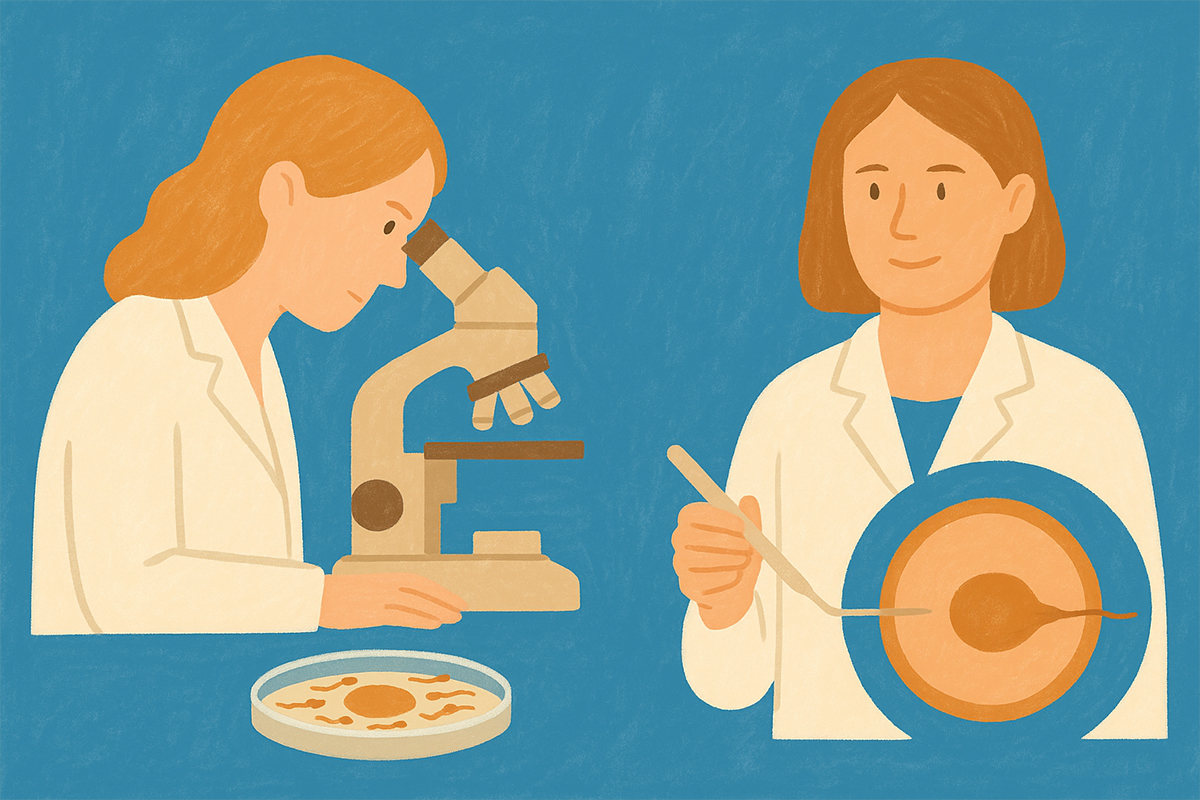
ICSI means intracytoplasmic injection. During the ICSI procedure, the embryologist selects under the microscope a single sperm cell with superior morphology and motility and injects it with a micropipette directly into the oocyte cytoplasm, significantly increasing the chances of oocyte fertilization and embryo formation.
The ICSI procedure is used in cases of severe male infertility.
At Genesis Athens Clinic, both IVF and ICSI are available, and the choice of procedure is made individually, depending on each couple’s fertility history and medical profile.
What is IVF (In Vitro Fertilization)?
In Vitro Fertilization (IVF) means that fertilization takes place in the laboratory, but in a way identical to the natural process that occurs in the fallopian tubes (natural contact between the oocyte and sperm cells).
Each IVF cycle includes the following steps: controlled ovarian stimulation, treatment monitoring, oocyte retrieval, in vitro fertilization, and embryo transfer into the uterine cavity.
IVF is used in the following diagnoses:
- Tubal infertility: occlusion of the fallopian tubes (blocked tubes), absence of fallopian tubes
- Endometriosis
- Diminished ovarian reserve (few oocytes in the ovaries)
- Advanced reproductive age of the mother
- Male infertility
- Failure of previous intrauterine inseminations
- Unexplained infertility
Natural cycle IVF and IVF with ovarian stimulation
In conventional IVF, you receive hormone treatment both for ovarian stimulation and for preventing spontaneous ovulation, so that several mature oocytes can be retrieved.
Natural cycle IVF means that you do not receive hormone treatment. The doctor retrieves one oocyte per natural cycle, which is then fertilized in the laboratory.
IVF with cryopreserved embryos
The IVF procedure with cryopreserved embryos can be used if you have already completed an IVF cycle. Oocytes have been retrieved and, in the laboratory, viable embryos have resulted. The procedure can be carried out a few months or even several years later.
IVF with elective single embryo transfer
If you have several embryos obtained through IVF but you wish to transfer only one into the uterus, this is possible. The procedure is called elective single embryo transfer. This type of transfer reduces the risk of a multiple pregnancy, which, however, is not higher than in a pregnancy obtained naturally.
IVF with donor oocytes
The conventional IVF procedure involves retrieving oocytes from the patient and fertilizing them with the partner’s sperm. However, the ovaries may not produce enough oocytes for a conventional IVF procedure. In IVF with donor oocytes, the eggs are taken from an anonymous donor. The oocytes are fertilized with the partner’s sperm, and then the resulting embryo is transferred into your uterus.
IVF with donor sperm
IVF with donor sperm is recommended when it is not possible to collect sperm either naturally or surgically.

What is ICSI (Intracytoplasmic Sperm Injection)?
ICSI means intracytoplasmic injection. In ICSI, you follow the same steps as in IVF. However, the oocytes are not fertilized in the laboratory through natural contact between the oocyte and sperm cells, as in IVF. In ICSI, a single sperm cell is injected directly into the oocyte under the microscope with the help of a micropipette. The procedure is performed by the embryologist. The ICSI procedure is used in cases of severe male infertility.
How is ICSI performed?
ICSI is performed after prior processing of the semen and under microscopic guidance, so that one single, best-quality sperm cell is selected to fertilize the oocyte.
The outer shell of the oocyte is temporarily removed, and the selected sperm cell is injected directly into the oocyte cytoplasm. The next day, the embryologist checks whether fertilization has occurred correctly.
How is severe male infertility identified?
A spermogram (semen analysis) is the first test performed in an infertile couple. The spermogram is a laboratory analysis of semen.
Proper preparation for a spermogram is essential for obtaining relevant results. Before the test, it is recommended to avoid ejaculation for 2 to 7 days in order to ensure a maximum number of sperm cells in the sample.
The semen sample for the spermogram can be collected at the clinic or at home, but the sample must be delivered to the laboratory within one hour, kept at room temperature, to avoid deterioration of the sperm cells.
How is the spermogram performed?
In the laboratory, the total volume of semen is measured, and the number of sperm cells per milliliter is counted, determining the percentage of motile sperm cells and the quality of their movement.
The shape and structure of the sperm cells are analyzed under the microscope, and additional tests may include pH evaluation and checking for the presence of leukocytes.
Normal values of semen analysis
Normal values of semen analysis are essential for assessing male fertility:
- Semen volume: between 1.5 and 7.6 milliliters
- Sperm concentration: between 15 and 259 million per milliliter
- Sperm motility (ability to move): between 40% and 81%
- Normal morphology: at least 4% of sperm cells with normal shape
- Time required for semen to liquefy: 15–30 minutes
- Sperm vitality: between 54% and 97%
- Semen pH: between 7.2 and 8.0
Abnormal spermogram values according to WHO
- Oligospermia: a low number of sperm cells – concentration below 15 million sperm cells per milliliter
- Low motility: fewer than 40% of sperm cells move normally
- Abnormal morphology: fewer than 4% of sperm cells have a normal shape
Causes of abnormal spermogram values may include genetic or medical factors. In oligospermia (low sperm count) or azoospermia (complete absence of sperm cells in semen), the doctor may recommend genetic tests.
If the fertility specialist diagnoses so-called severe male infertility, the ICSI procedure is indicated.
Advantages of each method: IVF vs. ICSI
Advantages of IVF
IVF means fertilization in the laboratory, but in a natural way. The female reproductive cell is brought into contact with the male reproductive cell.
In ICSI, by contrast, the sperm cell is injected by the embryologist directly into the oocyte under microscopic guidance. Intracytoplasmic sperm injection is, in fact, a microscopic surgical intervention in the oocyte.
With a very powerful microscope, a sperm cell is captured with a micropipette. It is then introduced into the oocyte by making a tiny opening in the external protective membrane of the egg, more precisely in its transparent area, the zona pellucida. This membrane protects the egg and the newly formed embryo in the first days of life.
The main advantage of IVF with ICSI is the higher success rate, when indicated. This applies if the spermogram shows severe male infertility, called azoospermia (absence of sperm cells), if the sperm count is very low (oligospermia), or when sperm morphology or motility are below normal limits.
In men who suffer from complete azoospermia (total absence of sperm cells), it is possible to retrieve sperm from the epididymis (PESA) or from the testicle (TESA) using a fine needle under local anesthesia.
Advantages of ICSI
Using ICSI, it is possible to solve cases in which there are enough sperm cells quantitatively, but which, for unknown reasons, cannot fertilize the egg through conventional IVF.
In men who suffer from complete azoospermia, there is the possibility of retrieving sperm from the epididymis (PESA) or from the testicle (TESA) with a fine needle under local anesthesia.
„Meritați să fiți ascultată, văzută, tratată cu respect și susținută pe tot parcursul vieții.”

Andreas Vythoulkas
Specialty Placeholder


How to choose the right procedure: IVF vs. ICSI
The decision is based on hormonal tests, assessment of ovarian reserve, transvaginal ultrasound, and a detailed spermogram, possibly supplemented by functional sperm tests. The patient’s age, oocyte quality, number of previous attempts, and any associated conditions (endometriosis, immunological factors, genetic factors) also influence the choice.
The fertility specialist is the only one who can recommend the optimal method after a complete diagnosis. At Genesis Athens Clinic, the decision is always made in a personalized way, based on discussion with the patients and the results of investigations. Dr. Andreas Vythoulkas, infertility specialist, analyzes each case individually and explains the advantages and limitations of IVF and ICSI so that couples can make an informed and realistic decision.
Success rates: IVF vs. ICSI
The success rate of IVF and ICSI depends on several factors, including the patient’s age, ovarian reserve, oocyte and sperm quality, and the experience of the embryology laboratory. In general, IVF has an average success rate of approximately 35–50% per cycle, depending on age and diagnosis. At Genesis Athens Clinic, IVF has a success rate of up to 60% per cycle, thanks to modern technology and ESHRE-certified embryologists, offering couples real chances of achieving a pregnancy.
In cases of severe male infertility, ICSI can increase the fertilization rate of oocytes, reaching up to 70% in well-selected situations.
ICSI is recommended especially when the spermogram shows values far below normal, when there is a history of fertilization failure with IVF, or when sperm obtained through surgical procedures is used.
Costs: IVF vs. ICSI
The costs of IVF vs. ICSI vary depending on the complexity of the case, the number of procedures required, and the services included in the package (ovarian stimulation, tests, additional procedures). In general, IVF has slightly lower costs because the laboratory fertilization process is less technically demanding. ICSI requires micromanipulation equipment and additional expertise from embryologists, which is reflected in a slightly higher cost.
However, in situations where male infertility is severe or there have been previous fertilization failures, ICSI can significantly increase the chances of success, making the investment justified. For up-to-date information on costs and any available support programs or facilities, it is recommended that you speak directly with the Genesis Athens team.

Frequently Asked Questions
What is the main difference between IVF and ICSI?
In Vitro Fertilization (IVF) means that fertilization takes place in the laboratory, but in a way identical to the natural process in the fallopian tubes (natural contact between oocyte and sperm cells). ICSI means intracytoplasmic injection. In ICSI, a single sperm cell is injected directly into the oocyte under the microscope with the help of a micropipette. The procedure is performed by the embryologist.
When does the doctor recommend the ICSI procedure?
In cases of severe male infertility.
What are the success rates for IVF vs. ICSI?
IVF: over 60% per cycle at Genesis Athens Clinic within Metropolitan Hospital.
ICSI: up to 70% in cases of male infertility.
Is ICSI safe for embryos?
The ICSI procedure does not affect embryo quality.
Can ICSI be combined with genetic testing (PGT-A)?
Yes, the embryo can be genetically tested before implantation.
What are the average costs for ICSI in Romania?
The entire procedure costs between 16,000 and 23,000 lei.

Why choose Genesis Athens for IVF vs. ICSI
Genesis Athens, Center of Excellence in Infertility Treatment, is the largest infertility treatment center in Romania.
Its own embryology laboratory is equipped with state-of-the-art technology, including equipment dedicated to micro-injection, which makes it possible to achieve results at international standards. The team of ESHRE-certified embryologists and fertility specialists work together to provide a personalized approach for every couple.
The clinic’s success rate exceeds the national average, and patients benefit from comprehensive counseling, from diagnosis through to pregnancy follow-up. By choosing Genesis Athens for IVF vs. ICSI, you gain access to medical expertise, modern technology, and empathetic support throughout your journey towards having the much-desired child.
Talk to an expert about
FIV vs. ICSI
IVF vs. ICSI | Differences, Benefits & Best Option
Specialist in Obstetrics and Gynecology
Similar Articles

National IVF Program 2025 | Stages, Eligibility & Costs
Specialist in Obstetrics and Gynecology

How to Choose the Right IVF Clinic
Specialist in Obstetrics and Gynecology

Egg Donation | What It Is, How It Works & When It’s Advised
Specialist in Obstetrics and Gynecology