

When people search for “In Vitro Fertilization success rates”, they are usually looking for a simple answer to a complicated question: “What are the chances in our case?” In practice, success in In Vitro Fertilization (IVF) cannot be reduced to a single percentage, because it depends on a combination of medical, biological and context-specific factors for each couple.
This article explains, in a general but medically accurate way, how In Vitro Fertilization success rates should be interpreted, why they vary from one case to another and which factors can genuinely influence the result. It also includes frequently asked questions with clear answers, in order to organize the information properly and avoid rushed conclusions. In this context, In Vitro Fertilization success rates should be seen as the result of a complete evaluation, not as a single percentage.
What are the success rates for In Vitro Fertilization?
The question of In Vitro Fertilization success rates only makes sense if it is clearly defined what “success” actually means. In everyday conversations, success may mean a positive test, but medically speaking there are several possible milestones, and these can significantly change how the “percentages” are perceived.
In general, In Vitro Fertilization success rates is a way of asking about the probability of achieving a pregnancy through IVF, but it is important to understand that the same procedure may have different outcomes depending on the criterion used: biochemical confirmation, ultrasound confirmation or live birth.
What “success” means in IVF and why the definition matters
In IVF, success may be discussed in several ways:
- positive pregnancy test, biochemical confirmation
- clinical pregnancy, confirmed by ultrasound
- live birth, the final goal and the most statistically relevant one
Sometimes, the information found online mixes these indicators or presents them without context. For this reason, two sources may appear to “contradict” each other, even though they are actually referring to different milestones.
Why there is no “universal” percentage valid for everyone
IVF is not a standard product, but a personalized medical procedure, and the outcome depends on the patient’s and partner’s medical profile, the cause of infertility, ovarian response to stimulation, the quality of eggs, sperm and embryos, as well as laboratory conditions and treatment strategy.
That is why, when the topic is In Vitro Fertilization success rates, the most useful thing is to understand the main factors and how they can be interpreted realistically, without promises and without fatalism.
The factors that most strongly influence In Vitro Fertilization success rates
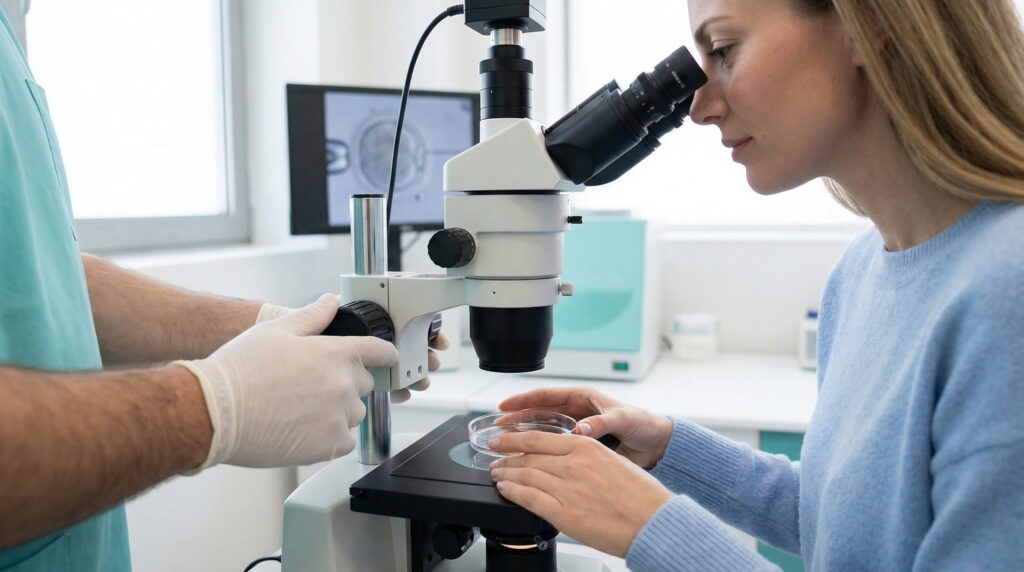
In most cases, In Vitro Fertilization success rates are influenced by a few major elements that carry more weight than surface-level details. Some are non-modifiable, for example age, while others can be optimized, for example certain hormonal imbalances, habits or medical conditions that affect implantation.
Age and ovarian reserve: the most important factor
The patient’s age is usually the most important factor, because it influences the genetic quality of the eggs and the ability to obtain viable embryos. At the same time, ovarian reserve, assessed through the usual markers, provides an estimate of how many eggs may be obtained in one cycle and how likely it is that enough embryos will be available for selection and transfer.
It is useful to remember the difference between quantity, how many eggs may be obtained, and quality, how likely it is that those eggs will lead to viable embryos. A high number of eggs does not guarantee success, and a low number does not exclude it, which is why interpretation must always be made in context.
Embryo quality and decisions made in the laboratory
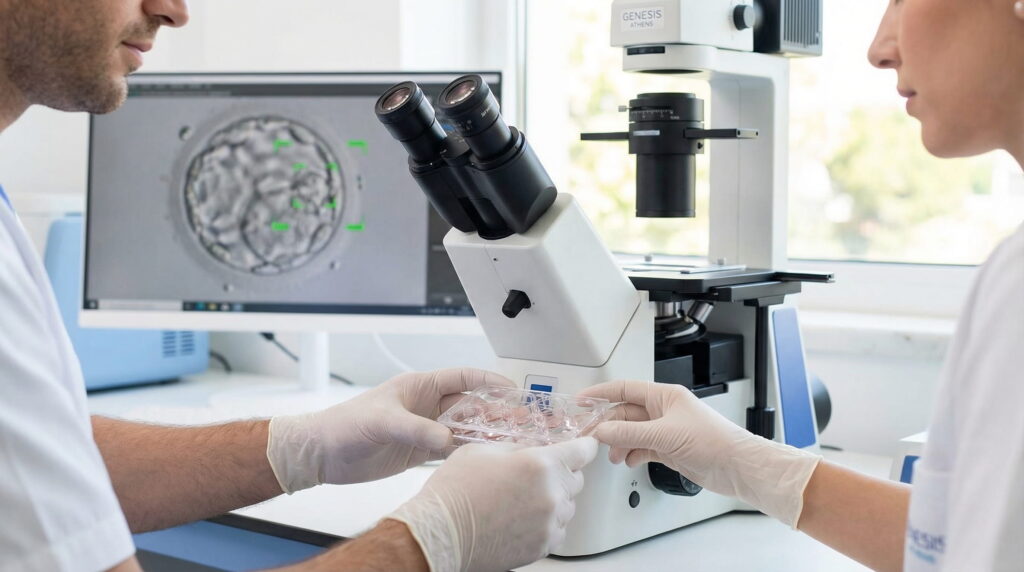
After fertilization, embryo quality becomes a major factor. What matters is how the embryos develop, the rhythm of cell division, morphological features and, in some situations, investigations recommended by the physician depending on the history.
Very often, when people search for In Vitro Fertilization success rates, they are actually looking for a guarantee related to the “perfect embryo”. In reality, a good-looking embryo increases probability, but does not offer certainty, because implantation also depends on endometrial receptivity and other biological variables.
For a broader presentation of the stages and medical logic of the procedure, there is also a complete guide to IVF that explains the sequence of steps and why each stage matters.
Male factor: a real role, sometimes underestimated
In many situations, the male component is relevant, even when the standard semen analysis appears “almost normal”. Parameters such as count, motility and morphology may matter, and in certain clinical contexts, sperm DNA integrity may also be evaluated, especially when there have been pregnancy losses or repeated failures. In some cases, this may directly influence In Vitro Fertilization success rates, especially when repeated failures exist.
It is important to avoid two extremes: neither automatically assuming that “the problem is only with the woman”, nor concluding that “male factor is impossible to overcome”. In practice, laboratory and treatment strategies are adapted according to the complete picture.
The endometrium and the conditions for implantation
Even with good-quality embryos, implantation depends on endometrial receptivity and the absence of problems that may interfere with the process. There may be situations in which the endometrium does not develop optimally, inflammation or imbalances require treatment or certain uterine conditions reduce the chances.
Here, proper evaluation and treatment planning can make the difference, especially in complex histories, and this directly influences In Vitro Fertilization success rates.
The cause of infertility and medical history
In Vitro Fertilization success rates are also influenced by the underlying diagnosis. Endometriosis, tubal disease, anovulation, male factor infertility or uterine problems may require different approaches. In addition, a history of previous pregnancies, pregnancy loss, uterine surgery and response to earlier treatments are important variables when the discussion is approached realistically.
Lifestyle and modifiable factors
Although they do not “replace” the medical side, lifestyle factors can influence fertility and the body’s response. The right approach is a balanced one: it should not be promised that lifestyle changes alone will “solve” the problem, but neither should it be ignored that they may support the outcome and, indirectly, In Vitro Fertilization success rates.
“You deserve to be heard, seen, treated with respect, and supported throughout your life.”

Andreas Vythoulkas
Specialist in Obstetrics and Gynecology


What can realistically improve the chances of success

In discussions about In Vitro Fertilization success rates, it is worth separating the marketing side from the medical side. There are things that can be optimized and things that cannot be completely “controlled”.
Realistically, improving the chances depends on a correct diagnosis, a personalized plan, a high-performing laboratory, good timing and careful management of factors that can be modified.
Here are several clear directions that are usually discussed before starting the procedure:
- complete evaluation of the cause of infertility, in both partners
- choosing the protocol that best fits the patient’s profile
- checking uterine and endometrial conditions before transfer
- adjusting the stages when history shows repeated failures or pregnancy losses
For eligible individuals interested in funded options, National IVF Program 2025 – complete guide may also be relevant, so that medical and administrative planning remain coherent.
Also, when comparing clinics or searching for the “best option”, the real difference is rarely found in a single detail, but in the consistency of the entire process. In this sense, how to choose an IVF clinic can help structure the criteria in a practical way.
Frequently Asked Questions
What are the success rates at the first procedure?
In general, the answer depends on age, the cause of infertility and the quality of the embryos obtained. For some, the first cycle may be successful. For others, adjustments may be necessary. That is why it is more useful to discuss the concrete case than to focus on a general percentage.
Does age influence the chances even if the tests are “good”?
Yes, age remains a major factor. Tests may suggest the potential to obtain eggs, but they cannot guarantee genetic quality. That is why age and clinical history are interpreted together.
If only a few eggs are obtained, are there still real chances?
Yes. The number of eggs matters, but it is not the only criterion. Sometimes, even with a small number of eggs, good embryos may be obtained and a transfer may succeed.
Can sperm quality reduce the chances even with ICSI?
ICSI can overcome certain fertilization-related problems, but it does not eliminate all variables. If there are factors affecting genetic integrity or biological quality, they may influence embryo development.
Does a “thin” endometrium mean the procedure cannot succeed?
Not necessarily. The endometrium is important, but there is no simple rule that applies to everyone. There are situations in which it can be improved or the transfer strategy can be adjusted.
Does blastocyst transfer automatically increase In Vitro Fertilization success rates?
Not automatically. In some situations it may be advantageous, in others not. What matters is how many embryos there are, how they develop and what the treatment history looks like.
What role does the cause of infertility play in In Vitro Fertilization success rates?
A significant one. Some causes respond very well to IVF, while others may require additional steps before transfer. That is why interpretation must be made in the context of the diagnosis.
What can be done after a failed attempt to improve the chances in the next one?
Usually, the stages are reanalyzed: response to stimulation, embryo quality, uterine conditions and possible associated causes. Sometimes small adjustments are needed, while other times a change of strategy is necessary.

Why choose Genesis Athens for In Vitro Fertilization
In a process where expectations are high, the difference is made by the way everything is managed end to end: from evaluation and planning to laboratory work, monitoring and medical communication. Genesis Athens places emphasis on a personalized approach and on clinical decisions based on the context of each individual case.
For those who prefer to complement the information with a medically grounded perspective explained in accessible terms, there are also the physician’s educational resources, including In Vitro Fertilization – treatment, as well as the patient’s IVF experience. In addition, for structuring selection criteria, how to choose an IVF clinic adds a useful framework for comparison.
In the end, In Vitro Fertilization success rates are not a slogan, but the result of a medical equation. When that equation is properly understood and approached methodically, the next steps can be built with more clarity and coherence.
Talk to a specialist about
IVF Success Rates

Sources:
In Vitro Fertilization: Success Rates and the Factors That Influence Them
Specialist in Obstetrics and Gynecology
Similar Articles

The Vaginal Microbiome and Fertility: Why the Balance of Intimate Flora Matters
Specialist in Obstetrics and Gynecology

IVF vs. ICSI | Differences, Benefits & Best Option
Specialist in Obstetrics and Gynecology

Perimenopause: What Changes Occur and How Fertility Can Be Influenced
Specialist in Obstetrics and Gynecology