

Infertility is a common medical reality, and the male factor can contribute significantly in couples who face difficulties achieving a pregnancy. In many situations, investigations show that the partner’s sperm cannot be used safely or effectively as part of an assisted reproduction plan. In this context, sperm donation becomes a mature, safe, and ethical medical option—and for some couples, sperm donation is the step that makes pregnancy possible when biology has imposed limits.
At Genesis Athens, we approach sperm donation with the rigor of an elite center: careful donor selection, extensive screening, traceability and confidentiality, and a results-oriented approach with no compromises on the future child’s safety. If you’d like to go straight into details about options, steps, and the medical pathway, you can find the essentials on our dedicated sperm donation page.
For patients, the decision to move forward with sperm donation is not only a “technical” one—it’s also deeply personal. That’s why we explain clearly what sperm donation means, how selection works, and what guarantees exist regarding biological safety and confidentiality, so that couples or individuals choosing sperm donation can make an informed, calm decision.
And when the medical context indicates interventions involving the female gamete or a complementary alternative, you can consult our egg donation page. If you want a broader, step-by-step picture—including selection and preparation—the article Egg Donation – Complete Guide complements the perspective very well, especially for those who want to understand the differences between the two donation types and how they fit into a treatment plan.
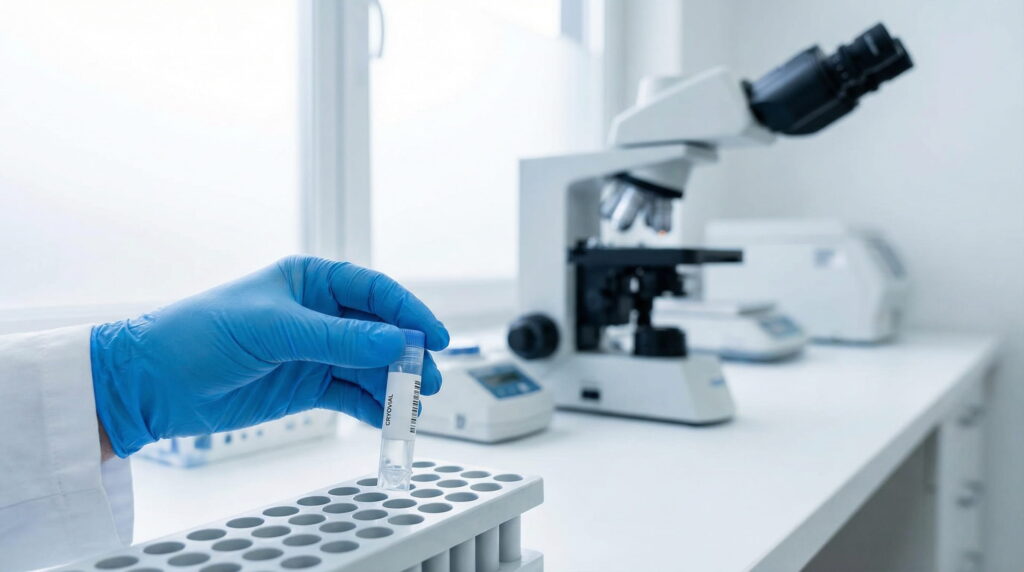
What does sperm donation mean and when is it recommended?
Sperm donation involves using sperm from a carefully selected and thoroughly tested donor as part of assisted human reproduction procedures. It is considered when there is severe male infertility (for example, absence of sperm cells or parameters incompatible with achieving pregnancy), when there are significant genetic risks that are not desired to be passed on, or in situations where there is no male partner.
Depending on the patient’s medical profile and the indication established in the clinic, donated sperm can be used for intrauterine insemination (IUI) or in vitro fertilization (IVF) procedures, including with ICSI when justified by the laboratory context. If you want a complete overview of the steps and the lab journey, you can also read In Vitro Fertilization (IVF) – Complete Guide.
Who can become a donor?
At Genesis Athens, the sperm donation program is built on a simple principle: we accept only donors who meet clear criteria for medical safety and responsibility, to protect both the future child and the patients undergoing treatment.
Eligibility criteria (in plain language)
A candidate can be accepted as a donor if they broadly meet the following conditions:
- Age: usually between 18 and 35 years old (sometimes up to 40, depending on medical evaluation).
- Good overall health: no major chronic diseases or conditions that can affect sperm quality.
- Favorable family history: no history suggestive of severe genetic diseases in the family (medically assessed).
- Full medical testing: willingness to undergo lab tests and repeated check-ups, according to the clinic’s protocol.
- Psychological balance and responsibility: understanding that sperm donation is a serious decision with long-term implications.
- Healthy lifestyle: no drug use, no alcohol abuse, and ideally non-smoking; sleep and routines that support reproductive health.
- Availability and consistency: respecting appointments and recommendations (including abstinence periods before collection, when applicable).

Why are these criteria so strict?
Because sperm donation is not just about sample collection, but a complete medical process in which biological quality, safety, and traceability must be impeccable.
For an additional medical perspective explained in patient-friendly language, you can also consult Dr. Andreas Vythoulkas’ resources on Sperm Donation.
Medical screening: the Genesis Athens protocol
In a sperm donation program, “screening” doesn’t mean just a few routine tests—it’s a comprehensive medical filter designed to deliver maximum safety and predictability. At Genesis Athens, each donor is evaluated in two directions: the biological quality of the sample (so it can be used effectively in treatments) and medical safety (to reduce risks for the patient and the future child). That’s why the protocol includes staged testing and, when necessary, repeated checks.

Sperm assessment: not only “how it looks now,” but also after freezing
The first step is a semen analysis, which evaluates essential parameters such as concentration, motility, and morphology. In parallel, we assess how the sample behaves after cryopreservation (known as a cryo-resistance test). This detail matters: a sample may look good at collection but decline significantly after freezing/thawing. That’s why we specifically track post-thaw survival and select samples that preserve quality—especially when intended for laboratory procedures such as IVF.
If you want to see how such samples integrate into the full laboratory pathway, you’ll find useful explanations in In Vitro Fertilization (IVF) – Complete Guide.
Biological safety: infectious testing and retesting, per protocol
The second essential component is infectious safety. Typically, screening includes testing for HIV, hepatitis B and C, syphilis, and Chlamydia, complemented according to protocol and the physician’s indication. In serious sperm donation programs, we don’t rely on a single set of tests; retesting is also performed (based on the internal schedule) to reduce the risk that a very recent infection might not be detected immediately. This is one reason samples are managed in stages and used only after safety criteria are met.
The genetic component: reducing risks where medicine allows
Depending on the case and protocol, genetic tests may also be recommended, such as karyotyping and carrier screening for certain relevant genetic conditions (for example cystic fibrosis, SMA, and others). The purpose is not “genetic perfection,” but reducing the risk of transmitting severe diseases when medically indicated. In a high-standard sperm donation program, this step complements biological assessment and supports long-term safety.
A unified standard: the same rigor for the female gamete
We apply the same discipline of selection and safety in female-gamete programs, so the clinical standard remains consistent regardless of donation type. You can read more in Egg Donation – Complete Guide and on our egg donation page.
The sperm donation procedure: what a clinic visit involves
The process is designed to be as discreet and professional as possible:
- Initial evaluation: a discussion with the specialist physician about family history.
- Abstinence period: the donor must follow 2 to 5 days of sexual abstinence before collection.
- Sample collection: performed in a dedicated, private space that meets the highest hygiene standards.
- Quarantine: samples are stored in liquid nitrogen at -196°C. According to safety protocols, they are used only after the donor returns at 6 months for repeat infectious disease testing.
The legal framework and anonymity in Romania
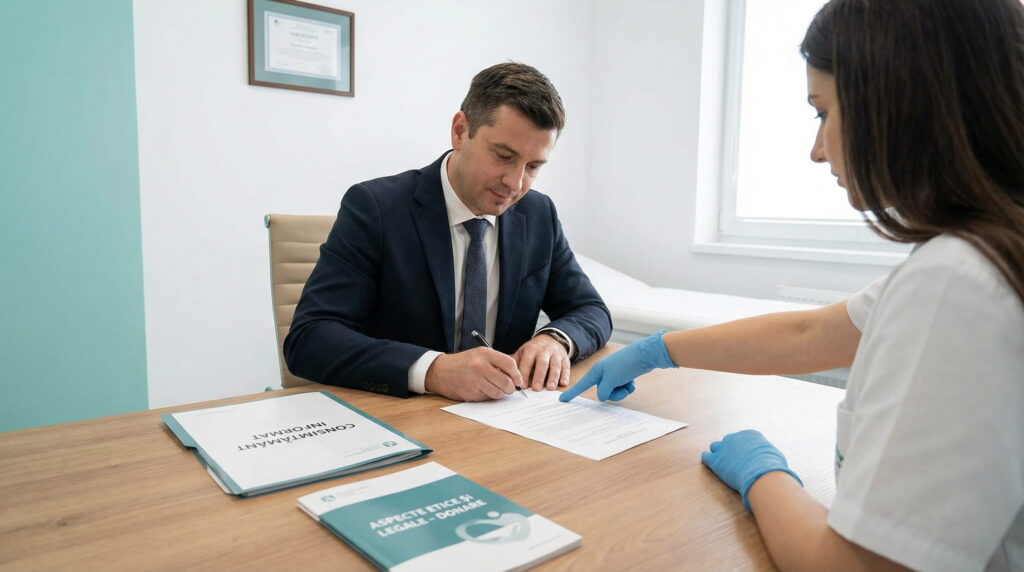
In practice, donation is carried out under strict confidentiality principles, with documentation and informed consent. At Genesis Athens, the donor’s identity is protected, and data is handled under secure conditions, with limited access and clear confidentiality rules. The recipient may receive non-identifying information (for example general traits, basic compatibilities, certain profile elements) without enabling identification of the donor. At the same time, all legal and administrative aspects are explained and assumed through documents before samples are used.
To consult the official framework in Romania, you can check the updated version of the legislation on the Legislative Portal – Law no. 95/2006 (Title VI) and the technical requirements/norms for donation and management of human tissues and cells, published in institutional format.
“You deserve to be listened to, seen, treated with respect, and supported throughout your life.”

Andreas Vythoulkas
Specialist in Obstetrics and Gynecology


Frequently Asked Questions
How long does the entire selection process take?
From the initial evaluation to the final acceptance, the process can usually take several weeks, depending on your availability and the processing times of the tests (especially genetic ones).
Does sperm donation affect your fertility in the future?
Typically, no. Sperm production is a continuous process, and sperm donation does not “deplete” reserves and does not reduce your ability to have children later, when you are healthy and follow medical recommendations.
Who benefits from donated sperm?
Most commonly, couples with severe male infertility, situations involving genetic risk, or individuals who choose this option as part of their reproductive plan benefit.
Can you donate if you recently had tattoos or piercings?
Usually, there is a deferral period (often up to 6 months), for safety reasons related to infections in the detection “window” period. The final decision is established after evaluation and protocol.
How many samples do you need to provide?
It depends on the program plan and the quality of the samples. In certain situations, you may be recommended to provide multiple collections over a determined period, so that there is an adequate and usable stock.
Is there financial compensation?
Donation is, essentially, an altruistic gesture. However, the clinic usually covers the costs of medical investigations and may offer compensation for logistical expenses (transport/time), within the limits of the applicable framework.
How is compatibility with the recipient chosen?
The matching of parameters such as phenotype and basic compatibilities (for example blood group) is pursued, so that the choice is medically responsible and balanced.
Is the confidentiality of your data protected?
Yes. The data are managed under secure conditions, with limited access and strict confidentiality rules. The donor is identified through internal codes, and personal information does not appear in the recipient’s file.

Why choose Genesis Athens for sperm donation
Genesis Athens is an integrated infertility treatment center that emphasizes medical standardization, a top-tier laboratory, and person-centered care. For you, that means a clear pathway with well-defined steps, decisions based on medical evidence, and strict quality control across all stages involved in sperm donation.
The difference is most visible in the laboratory. We have our own embryology lab and advanced infrastructure, so samples used in treatment are processed and stored under precise, traceable conditions. The embryology team follows up-to-date protocols applied consistently even in complex cases, and sample evaluation doesn’t stop at collection: we monitor relevant parameters and post-thaw behavior so that the biological material used remains stable and effective in real laboratory conditions.
At the same time, we don’t treat “cases,” we treat people. The plan is personalized based on the biological profile and medical history of the recipient patient/couple, and communication remains clear, realistic, and transparent throughout. When a decision carries emotional impact, give yourself space and support: our team can guide you through options and steps, so the entire process is not only medically correct, but also manageable on a human level.
Speak with a specialist about
Sperm Donation

Sources:
- Legea nr. 95/2006 – reforma în domeniul sănătății (Titlul VI)
- Ministerul Sănătății – cerințe tehnice pentru țesuturi și celule umane
- UE – Directiva 2004/23/CE (calitate și siguranță pentru țesuturi și celule)
- UE – Directiva 2006/17/CE (cerințe tehnice pentru donare și testare)
- WHO – Manualul de laborator pentru examinarea spermei umane (ediția a 6-a)
- ESHRE Working Group on Reproductive Donation (2022) – Good practice recommendations for information provision for those involved in reproductive donation (Human Reproduction Open)
Sperm Donation | Complete Guide
Specialist in Obstetrics and Gynecology
Similar Articles

hCG: What It Is and When It Becomes Important
Specialist in Obstetrics and Gynecology

The First Period After an Unsuccessful IVF Cycle: When It Happens and What to Expect
Specialist in Obstetrics and Gynecology

How Long IVF Treatment Takes: Stages, Timeline and When Results Appear
Specialist in Obstetrics and Gynecology