

Căutarea „test fertilitate femei” aduce, de multe ori, rezultate care seamănă mai degrabă cu un produs (test rapThe search for “female fertility test” often brings up results that resemble more of a product (rapid test) or a standard laboratory package. In practice, a useful female fertility test is a staged evaluation: it includes fertility analyses selected according to cycle timing, medical history and the purpose of the investigation, and is sometimes complemented by investigations such as transvaginal ultrasound.
In practice, a well-chosen female fertility test does not stop at sample collection, but helps correctly frame the next steps: whether simple measures are sufficient, whether additional investigations are needed or whether a discussion about treatment options is taking shape. For context regarding stages and the medical pathway, the complete guide to In Vitro Fertilization (IVF) may serve as a useful reference point.
What “Female Fertility Test” Means and What It Does Not Mean
In everyday language, “female fertility test” may mean different things:
- a rapid screening test (for example, some tests monitor certain hormonal indicators, but cannot fully describe ovarian function);
- a set of laboratory analyses (hormones, ovarian reserve markers, associated tests);
- a complete medical evaluation, where analyses are interpreted in context and the next steps are decided.
The important difference is that a rapid test or a standard package cannot cover all scenarios. Therefore, the recommended approach is to start with basic analyses and then add only what is relevant for the specific situation.
Basic Analyses in a Female Fertility Test

A female fertility test usually begins with analyses that provide information about ovulation, ovarian reserve and hormonal balance. In practice, the following are frequently encountered:
- AMH (anti-Müllerian hormone) – a useful marker for ovarian reserve (in interpretation, context matters greatly, not just the isolated value);
- Early cycle hormones (usually day 2–3): FSH, LH and estrogen (estradiol);
- Progesterone (usually in the second part of the cycle, to confirm ovulation);
- TSH (and, when necessary, additional thyroid tests) – because thyroid function may influence the cycle and ovulation;
- Prolactin (especially when there are cycle disturbances or associated symptoms).
At this stage, the package may naturally anchor into hormonal analyses, since an important part of evaluation is based on hormonal profile and correct timing of collection.
When Tests Are Performed: Why Cycle Timing Matters
One of the most frequent sources of confusion is “on which day should tests be done?”. The answer differs depending on the test:
- Basic hormones (FSH/LH/estradiol) are usually collected at the beginning of the cycle (often day 2–3), for comparability.
- Progesterone is measured in the second part of the cycle (after ovulation), precisely to verify whether ovulation has occurred.
- AMH may be collected in many situations independently of cycle day, however interpretation remains medical and contextual.
- For TSH, collection usually follows simpler rules than cycle hormones, but consistency and correct interpretation are still important.
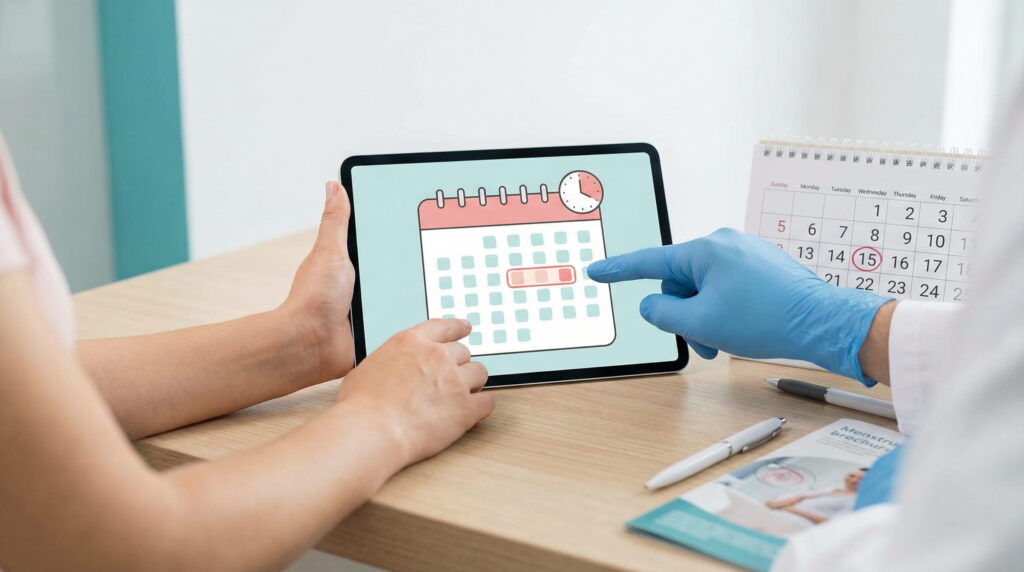
When a more complete evaluation is desired or when symptoms are present (pain, abnormal bleeding, suspicion of cysts, fibroids etc.), transvaginal ultrasound may provide essential data about the ovaries and uterus in a rapid and non-invasive manner.
How to Choose the Right Package (Without Unnecessary Investigations)
A good package is not necessarily “the largest”, but the one that answers a clear medical question. In practice, selection is made according to several criteria:
- Age and duration of attempts: after 35, evaluation is often accelerated; if the period of trying is longer, targeted investigations are introduced sooner.
- Cycle regularity: an irregular cycle may require emphasis on ovulation and hormonal profile (including TSH, prolactin, sometimes androgens).
- Associated symptoms: significant menstrual pain, intermenstrual bleeding or prior medical history may direct toward additional investigations.
- Immediate objective: basic clarification vs. preparation for treatment.
If investigations show that treatment steps are needed, information about In Vitro Fertilization (IVF) may become relevant as the next stage in the medical pathway.

Within the educational ecosystem, a complementary presentation of options and medical steps can also be found in IVF (treatment), and for the human component of the journey (understanding stages, realistic expectations, frequently asked questions in practice), the perspective in IVF – patient experience may also be useful.
“You deserve to be heard, seen, treated with respect and supported throughout your life.”

Andreas Vythoulkas
Specialist in Obstetrics and Gynecology


Frequently Asked Questions
What does a female fertility test usually include?
It usually includes fertility analyses that assess ovarian reserve (e.g., AMH), cycle hormones (FSH/LH/estradiol), ovulation (progesterone) and sometimes TSH/prolactin. The exact set is determined according to the cycle and the purpose of evaluation.
Can AMH be done on any day of the cycle?
In many situations, AMH can be collected without strict dependence on cycle day. However, interpretation is done in context (age, ultrasound, cycle history), not based only on an isolated value.
Is TSH part of fertility testing?
Yes, it is frequently included, because thyroid function may influence ovulation and cycle regularity. Depending on the result and medical history, the physician may recommend additional tests.
Does progesterone show whether ovulation occurred?
Progesterone is often used as a marker of ovulation, if measured at the appropriate moment of the cycle (after ovulation). If timing is incorrect, the result may be difficult to interpret.
Why is estrogen (estradiol) important?
Estradiol correlates with ovarian activity and is usually interpreted together with FSH/LH in the first days of the cycle. It helps in understanding ovarian response, especially in basic evaluations.
Is a rapid fertility test sufficient?
A rapid test may sometimes provide orientation, but it cannot replace laboratory analyses and medical evaluation. Fertility is influenced by multiple factors that require integrated interpretation.
When is transvaginal ultrasound useful in this context?
It is useful for evaluating the uterus and ovaries (for example, ovarian appearance, possible cysts, fibroids, indicative follicle assessment). It is especially recommended when symptoms are present or when a complete evaluation is desired, not only laboratory analyses.
If results are “within limits”, does that mean there is no problem?
Not necessarily. Sometimes analyses may be within limits, but other causes may exist (for example, anatomical factors or other components of the couple). Therefore, results are interpreted together with medical history and, when necessary, additional investigations.

Why Choose Genesis Athens for a Female Fertility Test
Genesis Athens approaches testing as part of a coherent medical pathway: analyses are selected according to the clinical situation, collected at the correct timing and interpreted with emphasis on next steps. When evaluation shows the need for additional investigations or treatment options, the clinical framework allows natural integration of further investigations and subsequent stages, including options such as In Vitro Fertilization (IVF), when indicated.
Talk to a specialist about
female fertility test

Sources:
- American College of Obstetricians and Gynecologists (ACOG) – „Evaluating Infertility”
- American Society for Reproductive Medicine (ASRM) – „Fertility evaluation of infertile women” (Committee Opinion)
- NHS (UK) – „Infertility: Diagnosis”
- Centers for Disease Control and Prevention (CDC) – „Infertility: Frequently Asked Questions”
- NHS Greater Glasgow & Clyde – „Assessments and tests required before fertility treatment”
Female Fertility Test: Basic Investigations and How to Choose the Right Package
Specialist in Obstetrics and Gynecology
Similar Articles

Ovarian Pain During Pregnancy: Possible Causes, Associated Symptoms and When to See a Doctor
Specialist in Obstetrics and Gynecology

Bacterial Vaginosis: How It Influishes Fertility and What to Do Before Procedures
Specialist in Obstetrics and Gynecology

Genetic Tests During Pregnancy: What Options Exist and When They Are Recommended
Specialist in Obstetrics and Gynecology