

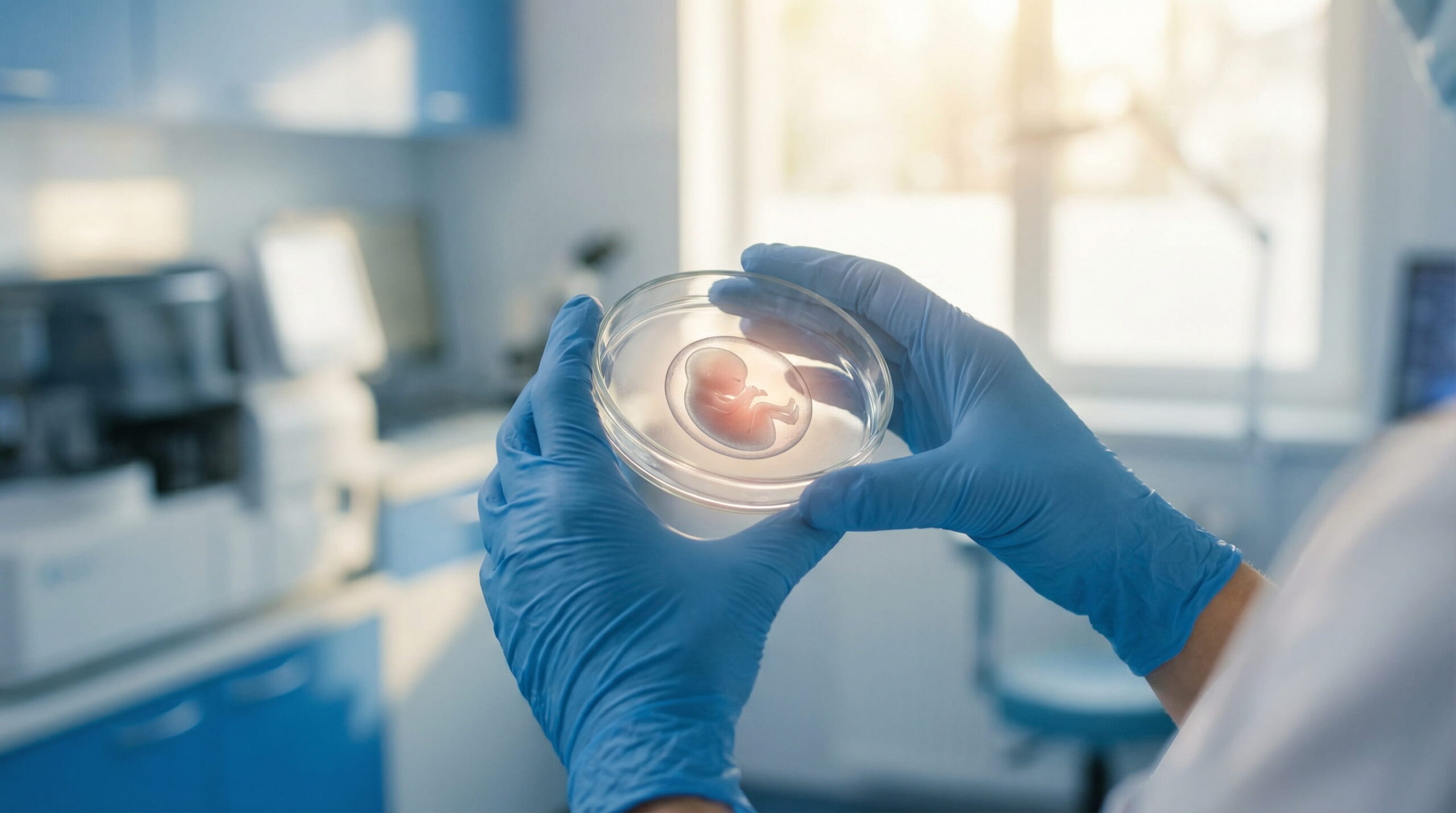
When achieving a pregnancy using your own eggs and/or your partner’s sperm is no longer possible—or no longer offers realistic chances—there are situations where embryo donation may be a clear, medically justified alternative. In practice, this means using an embryo already created in the laboratory from donated gametes, followed by careful endometrial preparation and embryo transfer under controlled conditions.
At Genesis Athens, we approach this topic with great care, because the decision is not only medical, but also deeply personal. That’s why our goal is to explain, step by step, how it works, what it involves for you, and which questions are worth clarifying from the very beginning. For the broader context (how the stages connect and why timing matters), our complete guide to in vitro fertilization (IVF) can also be helpful.
In the clinic, we see that this option becomes easier to understand when you separate it into two components: what relates to the embryo (its quality and stage) and what relates to you (the uterus, the endometrium, and the optimal window for transfer). In embryo donation, correct endometrial preparation and synchronization are the elements we can control best. The rest of the decision is built on clear information, predictable steps, and realistic expectations.
What is embryo donation, and how is it different from egg donation?

In IVF with donated embryos, the embryo comes from a donated egg and donated sperm and is transferred into the uterus after careful hormonal and ultrasound preparation. The essential difference from other forms of IVF is that, in this scenario, the embryo’s genetic material does not belong to the couple.
It’s important to distinguish embryo donation from egg donation. With egg donation, the egg is donated, but the sperm may belong to the partner (or may also be donated, depending on the case). With embryo donation, the embryo is already formed and available for transfer, and your treatment focuses on preparing the uterus and choosing the optimal transfer timing. If you’d like to compare indications and understand what egg donation involves, you’ll find detailed explanations on our dedicated egg donation page.
Who might be a good candidate?

In general, the discussion about embryo donation arises when there are strong medical reasons why using your own gametes is not possible or no longer offers reasonable chances. This can happen, for example, when ovarian reserve is very low or in severe ovarian insufficiency, including situations where the ovaries have been affected by previous treatments or procedures. There are also cases where the male factor is severe and obtaining viable sperm for fertilization is not possible or is extremely unlikely.
There are also situations where you have gone through multiple IVF attempts without success and a complete evaluation indicates that the probability of success with your own genetic material remains very low. In such contexts, embryo donation is not a “shortcut,” but an option that can bring treatment back into a realistic zone—one with clear steps and well-defined objectives.
In any situation, the recommendation is never made “in principle,” but after we understand your history and build a plan together. If you are at the stage where you want to understand the standard treatment steps, our IVF page may also be useful.
“You deserve to be listened to, seen, treated with respect, and supported throughout your life.”

Andreas Vythoulkas
Specialist in Obstetrics and Gynecology


How the process works

The initial consultation and treatment planning
The first step is to understand your specific context: what attempts have been made, which investigations were done, how you responded to treatments, and which medical factors may influence implantation and the course of pregnancy. At this stage, we focus particularly on the uterus (uterine cavity, endometrium, possible formations or inflammation) and your general health, because these are the elements we can address directly before transfer.
Sometimes we may need to complete investigations or treat certain issues before starting endometrial preparation. The goal is not to proceed with a transfer “in a rush,” but to proceed with a transfer that is properly prepared.
Embryo selection and safety criteria
In systems where embryo donation is available, embryos come from procedures performed under laboratory and biological safety conditions, with screening and traceability protocols. For you, the most important thing is to have a clear picture of the medical criteria and steps: what information is available about donors (within the applicable legal framework), what screening has been performed, and the rationale behind embryo selection.
In practice, we help you understand exactly what “matching” means and which criteria truly matter for implantation chances—without unrealistic promises and without vague terminology.
Endometrial preparation—the step that makes the difference
Although it’s sometimes said that “embryo donation is simpler,” the reality is that success depends heavily on uterine preparation. The endometrium must reach appropriate parameters and be correctly synchronized with the embryo’s stage. This is done through medical protocols (usually estrogen and progesterone), adjusted based on your response and monitored through ultrasound scans.
This is the stage where we guide you step by step: when treatment starts, how we track the endometrium, what a good response looks like, and how we establish the optimal transfer window. If you want the bigger picture on stage synchronization, we recommend our complete IVF guide again, because it explains the “timing logic” in assisted reproduction very clearly.
The embryo transfer and the period afterward
Embryo transfer is usually a short procedure, performed gently and without general anesthesia. After transfer, you continue supportive treatment according to the agreed plan, and the pregnancy test (β-hCG) is done at the time recommended by your doctor. If the test is positive, the next step is ultrasound confirmation and early pregnancy monitoring.
To better understand how this stage feels and which questions often come up, you can also read the patient experience in IVF.
During this period, our role is to provide a clear framework: what is normal to feel, what should be monitored, when to contact us, and what the next steps look like—regardless of the outcome.
What influences the chances of success?

In embryo donation, there are two major categories of factors. The first relates to the embryo: its quality, laboratory conditions, cryopreservation, and how transfer is managed. The second relates to you: endometrial status, uterine health, hormonal balance, and general factors (metabolic, thyroid, inflammation, lifestyle).
From our perspective, “chances” shouldn’t be presented as a standalone number, but as a concrete optimization plan. That means proceeding with transfer only after we have assessed the uterus, adjusted the preparation protocol, and clarified potential risks or obstacles. The objective is to reduce as much as possible the variables we can control.
Key topics to discuss before you begin
Before starting this path, it helps to clarify a few things that, in practice, reduce stress and improve plan coherence: how many transfers are anticipated in your scenario, what strategy is in place if the first transfer doesn’t result in pregnancy, how medication and monitoring are managed, and what steps follow immediately after the pregnancy test.
We encourage you to ask for clear explanations and not to leave with “probably” or “we’ll see.” In assisted reproduction, plan clarity matters as much as medication.
Frequently Asked Questions
Is embryo donation the same as “embryo adoption”?
The term “embryo adoption” is frequently used in common language. Medically, we refer to IVF with donated embryos and embryo transfer. For context about the basic treatments from which this pathway derives, you can also consult the explanations about in vitro fertilization (IVF).
Will I need ovarian stimulation?
In most cases, no. In embryo donation, your treatment focuses on preparing the endometrium and on the correct synchronization for transfer, not on oocyte retrieval.
How long does it take until embryo transfer?
The duration differs from patient to patient, depending on the necessary investigations and on how the endometrium responds to the preparation protocol. Usually, after the initial evaluation stage, a few weeks of treatment and monitoring follow until the optimal window for transfer.
What tests or investigations are usually necessary before starting?
Before transfer, we primarily aim to evaluate the uterus and the general health status. Depending on your history, transvaginal ultrasound, general tests and infectious screening may be needed, and sometimes additional investigations of the uterine cavity, if there are suspicions (for example, polyps, adhesions, or endometrial inflammation).
What matters most for implantation?
In practice, the quality of the embryo and the receptivity of the endometrium matter. That is why uterine preparation and establishing the optimal moment of transfer are treated with maximum attention, in order to reduce controllable variables as much as possible.
If I have had repeated IVF failures, does it make sense to discuss this option?
It may make sense, but always after we analyze together what happened in the previous attempts and which factors can be optimized. Sometimes the solution is adjusting the protocol; other times, changing the strategy. For a complete understanding of the steps and the logic of the treatment, our complete guide about in vitro fertilization (IVF) may help you.
What happens after embryo transfer?
After the transfer, you will follow the recommended support regimen, and the pregnancy test (β-hCG) is performed at the time indicated by the doctor. If the test is positive, the next step is the confirmation ultrasound and early pregnancy monitoring, with clear indications regarding medication and follow-up visits.
Is a single embryo transferred or more?
The decision is made individually, depending on your medical profile and the team’s recommendations. In general, the modern approach aims to achieve a healthy pregnancy while reducing the risks associated with multiple pregnancy, and the number of transferred embryos is discussed transparently before the procedure.

Why choose Genesis Athens for embryo donation?
At Genesis Athens, we offer a structured approach to embryo donation, centered on medical safety, transparency, and coordination. We begin with a consultation where we clarify your medical history and determine which investigations are needed before transfer, with a focus on uterine assessment and factors that may influence implantation.
Endometrial preparation follows an individualized protocol, with ultrasound monitoring and adjustments when needed, so the transfer is scheduled in the optimal window. In parallel, we explain the steps concretely: what treatment involves, what medication you will take, how progress is monitored, and what milestones to expect after embryo transfer (the β-hCG test and the confirmation ultrasound).
Throughout your journey, you have access to complete medical information and useful resources about related treatments, including egg donation and IVF. For a broader overview of stages and synchronization, you can consult our complete IVF guide.
After transfer, we provide a clear plan for the waiting period and next steps—regardless of the outcome—so you know exactly when and how monitoring continues and what decisions may be needed next.
Speak with a specialist about
Embryo Donation
Sources:
- ASRM – Defining embryo donation (Ethics Committee Opinion, 2023)
- ASRM – Guidance regarding gamete and embryo donation (Practice Committee)
- HFEA (UK) – Donating your embryos
- NHS (UK) – Embryo Donation (information for donors)
- PubMed – Guidance regarding gamete and embryo donation (rezumat/articol științific)
How Embryo Donation Works
Specialist in Obstetrics and Gynecology
Similar Articles

AMH and Ovarian Reserve: How Values Are Interpreted and What They Mean for IVF
Specialist in Obstetrics and Gynecology

Fertilization of Eggs and Embryo Culture in IVF: How It Takes Place in the Laboratory
Specialist in Obstetrics and Gynecology

Egg Donation | What It Is, How It Works & When It’s Advised
Specialist in Obstetrics and Gynecology