

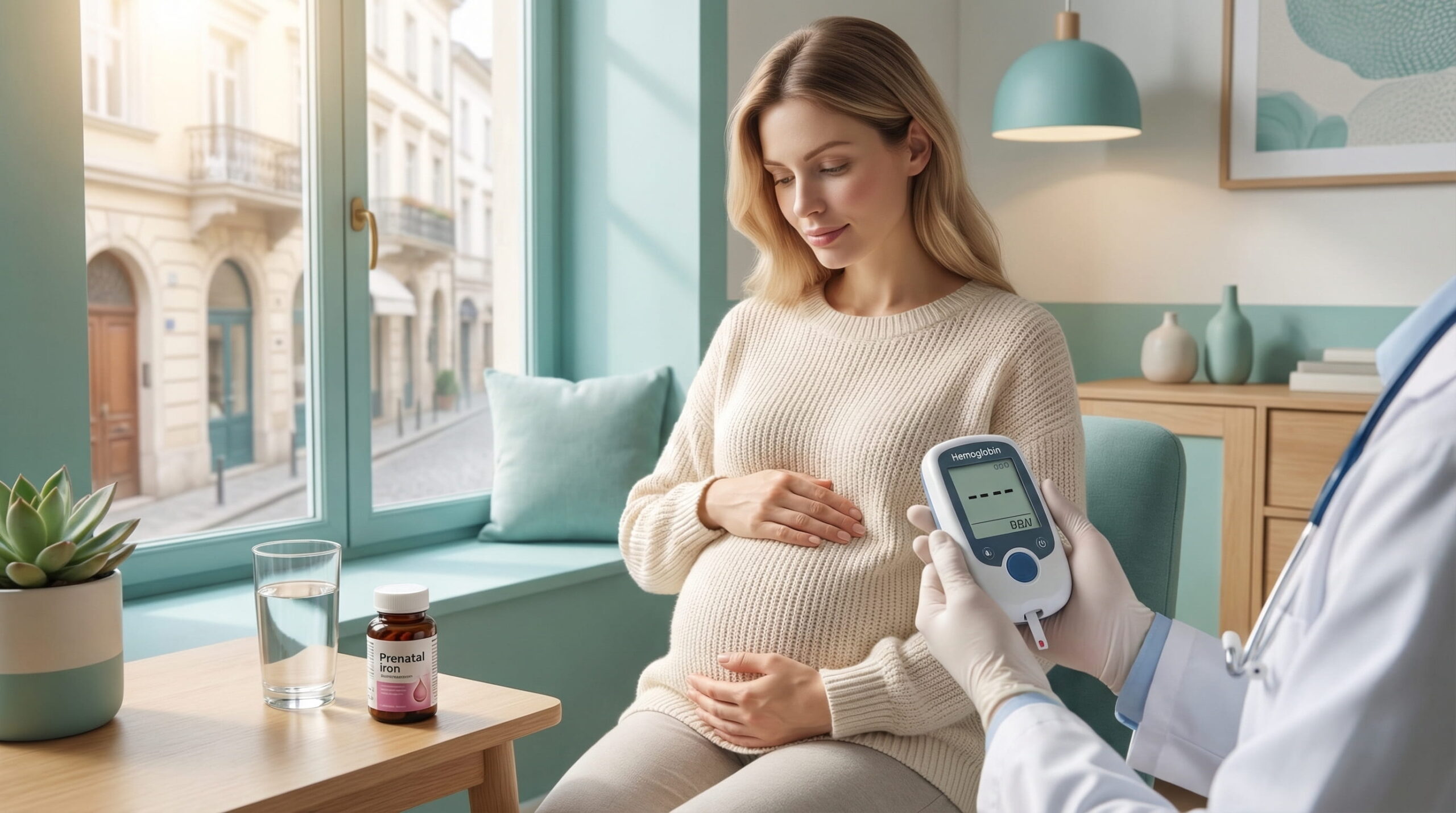
Pregnancy brings important changes in the body, and one of the most common is the modification of iron requirements and hematological parameters. For this reason, preparation for a pregnancy after IVF and careful pregnancy monitoring remain essential, including for the early identification of problems that may influence the pregnant woman’s general condition. In this context, anemia in pregnancy is a relatively common situation that deserves proper evaluation and management without alarmism, but with medical responsibility.
Why Anemia in Pregnancy Occurs
In many cases, anemia in pregnancy occurs because the body needs more iron to support the increase in blood volume, the development of the placenta and the needs of the fetus. In practical terms, during pregnancy there is a higher demand for resources, and if maternal reserves are not sufficient, a decrease in hemoglobin may occur.
The most common form is iron deficiency anemia, meaning anemia related to iron deficiency. However, not every case of anemia in pregnancy has the same cause. Sometimes there may be other explanations, such as insufficient dietary intake, absorption difficulties, blood loss before pregnancy or, more rarely, folic acid or vitamin B12 deficiency. For this reason, the interpretation of tests must be made in the clinical context of each patient.
It is important to remember that pregnancy also produces a so-called physiological “hemodilution”, meaning an increase in plasma volume that is more marked than the increase in red blood cell mass. For this reason, some values change compared with the period outside pregnancy, and the difference between physiological adaptation and anemia in pregnancy must be established medically, not only on the basis of fatigue or a single test considered in isolation.
Especially in patients who have gone through reproductive evaluations or complex treatments, a broader health context is useful. For this reason, when pregnancy occurs after infertility or assisted reproduction procedures, it may be natural for information about in vitro fertilization (IVF) and subsequent monitoring to be integrated into a more careful approach to general health.
How It Manifests and When It Needs Evaluation
The manifestations may be subtle at first. Anemia in pregnancy may present through marked fatigue, weakness, dizziness, palpitations, shortness of breath with minor effort, pallor or difficulty concentrating. The problem is that some of these symptoms may be confused with the usual changes of pregnancy, which means that diagnosis cannot be based only on the sensations experienced.
For this reason, the complete blood count and, when necessary, additional tests such as ferritin or other markers recommended by the doctor can clarify whether this is a normal adaptation or anemia in pregnancy that requires intervention. The evaluation aims not only to confirm the diagnosis, but also to determine its severity, as well as the likely cause.
Mild anemia may be detected incidentally through routine tests, without important symptoms. In contrast, when values are lower or symptoms become evident, closer monitoring is necessary. In more pronounced forms, anemia in pregnancy may influence the body’s tolerance to effort, recovery after birth and, in certain situations, may be associated with greater obstetric risks. That is precisely why the correct approach does not mean dramatization, but timely intervention.
It is recommended that medical evaluation be requested without delay if persistent dizziness, a feeling of fainting, severe fatigue, tachycardia or repeated decreases in hemoglobin appear in the test results. In such cases, simply increasing the intake of iron-rich foods may not be enough.
How Anemia in Pregnancy Is Managed
Management depends on the cause, severity and stage of pregnancy. In mild forms, the doctor may recommend dietary adjustments and oral iron supplements, followed by monitoring of the response through tests. Usually, the aim is not only to increase hemoglobin, but also to restore iron stores when deficiency is confirmed.
Nutrition has an important role, but it should not be presented as the only solution in all cases. Dietary sources of iron, together with a balanced diet, may support correction of the deficiency, but moderate or significant anemia in pregnancy often requires treatment recommended by the doctor. Sometimes the regimen is adapted according to digestive tolerance, laboratory values and how quickly the problem needs to be corrected.
There are situations in which oral iron is not sufficient, is not well tolerated or does not manage to correct the values within an adequate interval. In these cases, the doctor may indicate other therapeutic options, including intravenous administration, when this is clinically justified. The choice is not made as a standard one, but individually, according to the complete picture.
In addition to treatment, the pace of monitoring also matters. Repeating the tests is important in order to see whether anemia in pregnancy responds to the intervention and whether adjustments are needed. In addition, a pregnancy followed in an organized medical setting allows correlation of symptoms, tests and reproductive history. For patients who have gone through a complex emotional and medical journey, including infertility, multidisciplinary support may matter. In this regard, psychological counseling for IVF couples may remain relevant even in the period after pregnancy is achieved, especially when concerns related to tests, treatment or pregnancy progression appear.
Also, when anemia in pregnancy is discussed in the context of a pregnancy achieved through assisted reproduction, it is useful for the patient to also have access to a broader picture of the medical stages involved, including through a complete guide about in vitro fertilization (IVF), naturally integrated into the Genesis Athens information ecosystem.
“You deserve to be listened to, seen, treated with respect and supported throughout life.”

Andreas Vythoulkas
Specialist in Obstetrics and Gynecology


Frequently Asked Questions
Does anemia in pregnancy appear only because of iron deficiency?
Not exclusively. Iron deficiency is the most common cause, but anemia in pregnancy may also have other explanations, including folic acid deficiency, vitamin B12 deficiency, certain pre-existing conditions or changes that must be interpreted in the physiological context of pregnancy.
Is it normal to have fatigue during pregnancy or can it indicate anemia in pregnancy?
Fatigue may be a usual manifestation during pregnancy, but it can also be one of the warning signs of anemia in pregnancy. The difference is not established only by symptoms, but through medical evaluation and tests recommended by the specialist.
Can anemia in pregnancy be corrected only through diet?
In mild forms, a balanced diet has an important supporting role. However, anemia in pregnancy is not always corrected only through diet. In many situations, supplements or other interventions established by the doctor are needed, depending on the tests and severity.
When does anemia in pregnancy become a problem that needs closer monitoring?
When symptoms are pronounced, when hemoglobin decreases significantly or when there is no response to the initial treatment, monitoring must be intensified. Proper evaluation helps prevent complications and choose the most appropriate medical management.

Why Choose Genesis Athens for Pregnancy Monitoring and Reproductive Health
Genesis Athens offers a medical setting focused on clarity, careful evaluation and continuity in care, aspects that are important both before conception and after pregnancy is achieved. In a field where reproductive history, tests and clinical context must be understood together, a coherent and well-organized approach can make the difference.
For patients who have gone through fertility investigations or assisted reproduction treatments, subsequent pregnancy monitoring requires rigor and balance. Genesis Athens integrates medical education, reproductive evaluation and responsible guidance toward the next steps, in an institutional style that is accessible and centered on the patient’s real needs.
Talk to a specialist about
Anemia in Pregnancy
Sources:
- World Health Organization (WHO) – Anaemia
- World Health Organization (WHO) – Daily iron and folic acid supplementation during pregnancy
- American College of Obstetricians and Gynecologists (ACOG) – Anemia in Pregnancy
- ACOG – Routine Tests During Pregnancy
- Centers for Disease Control and Prevention (CDC) – Pregnancy Complications: Anemia
Anemia in Pregnancy: Why It Occurs and How It Is Managed
Specialist in Obstetrics and Gynecology
Similar Articles

When Is the Right Time for Fertility Testing
Specialist in Obstetrics and Gynecology

Perimenopause: What Changes Occur and How Fertility Can Be Influenced
Specialist in Obstetrics and Gynecology

Female Fertility Test: Basic Investigations and How to Choose the Right Package
Specialist in Obstetrics and Gynecology