

Semen analysis, also known as a spermogram, is one of the first investigations recommended when a couple is trying to conceive and pregnancy is delayed—or when there are risk factors that may affect male fertility. It is simple in principle, but highly valuable: it provides information about the number, movement, and shape of sperm cells, as well as several semen fluid parameters that can influence overall sample quality.
At the same time, it helps to say something upfront that reduces anxiety: a spermogram is not a “verdict.” An abnormal result does not automatically mean infertility, and a result within reference limits does not guarantee an immediate pregnancy. Correct interpretation is always contextual: medical history, how long you’ve been trying, the partner’s age, and any urological symptoms matter just as much as the figures on the report. If you’d like to understand when additional investigations can be helpful, you’ll find a complete framework on our page about semen analysis and advanced testing.
What a spermogram is and when it’s recommended
A spermogram is a laboratory analysis of semen performed on an ejaculate sample. It evaluates both quantitative features (for example concentration and total sperm count) and qualitative features (especially motility and morphology). For many couples, this is the first logical step in male fertility evaluation because it is non-invasive and can quickly guide the next steps. In clinical practice, semen analysis is often integrated into a broader couple evaluation—especially when a treatment plan is already considered or IVF is on the table.

Semen analysis is typically recommended when pregnancy does not occur after a period of regular attempts, or when there are clinical reasons to evaluate sooner: history of genital infections, inguinal/scrotal surgeries, known varicocele, oncology treatments, occupational exposure to heat or toxic substances, or symptoms such as pain, scrotal discomfort, urinary changes, or discharge.
Sometimes your doctor may recommend repeating the analysis—not because “the first one was wrong,” but because semen parameters can vary over time and can be influenced by temporary factors (a recent infection, fever, intense stress, insufficient sleep). A second sample, collected correctly, helps confirm a real trend. How you are guided before collection matters a lot, which is why it’s worth reviewing the full recommendations in semen analysis and advanced testing.
How to prepare correctly before semen analysis
A useful semen analysis starts with correct preparation. Many labs recommend a few days of sexual abstinence before collection to standardize conditions as much as possible. The goal is not perfection, but consistency: the same rule before each collection makes results easier to compare.
Practical factors can also significantly influence results—sometimes without the patient realizing it. Fever or a recent illness can temporarily reduce semen quality, as can heavy alcohol intake, smoking, frequent exposure to high temperatures (sauna, hot baths, working in very hot environments), chronic sleep deprivation, or sustained stress. If you’re already reading about treatment options, a helpful “big picture” reference is the Complete IVF Guide, because it places evaluation (including male evaluation) in the context of the full pathway.
If you are on medication or taking supplements, it’s not recommended to stop anything on your own before testing. Instead, mention everything you take when discussing results, so interpretation is accurate. Often, the most useful discussion is when the report is reviewed alongside your history and next steps—especially when the couple already has a plan—and that is exactly the role of an integrated evaluation like the one described on our semen analysis and advanced testing page.
Collection—at the clinic vs at home

Collection can be done either in a dedicated space at the clinic or at home, depending on the center’s organization and the lab’s recommendations. The clinic-based option has a clear advantage: the sample reaches the lab quickly under controlled conditions, and the risk of delays or temperature exposure is lower.
Home collection can be practical for some patients, but it comes with essential conditions. The sample must be collected in a sterile container and then transported as quickly as possible to the lab, maintaining an appropriate temperature. Because time can influence motility assessment in particular, following the lab’s delivery instructions is important.
You may sometimes see pages in search results that mix medical information with the option to “purchase” the test (as a package/service). At Genesis Athens, the focus is on what matters clinically: correct collection, standardized analysis, and interpretation in context—with clear next steps. If a structured overview of evaluation stages and options would help, you’ll find it in semen analysis and advanced testing.
“You deserve to be listened to, seen, treated with respect, and supported throughout your life.”

Andreas Vythoulkas
Specialist in Obstetrics and Gynecology


What parameters appear on a spermogram
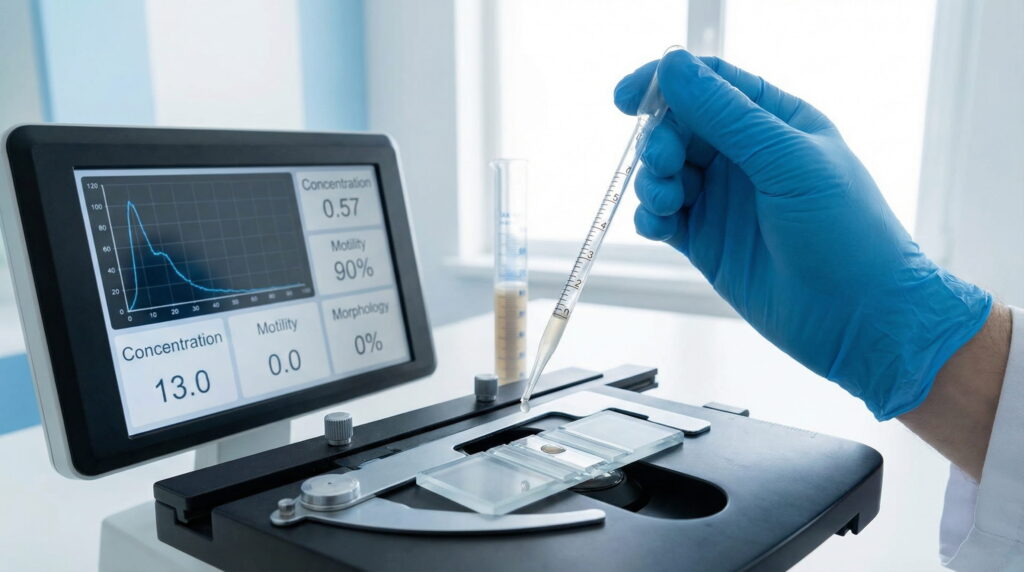
A spermogram report can look “technical,” but the logic is simple: it describes sample quality and sperm quality. Presentation may vary slightly between laboratories, but the core information is the same. Most questions cluster around three ideas: how many there are, how well they move, and how they look.
Typically, you’ll see parameters such as volume (and sometimes pH, viscosity, liquefaction time), concentration and total count, motility, and morphology. Some reports include vitality or indices suggesting inflammation. The key is not to fixate on a single number: interpretation is based on the overall picture, not one line.
Motility and morphology are often the main sources of questions. Motility describes not just “whether they move,” but whether movement is efficient enough to support reproductive function. Morphology does not mean “pretty” or “ugly”—it refers to standardized criteria regarding the head, midpiece, and tail of the sperm cell. In many cases, interpretation becomes much clearer when placed in the context of the couple’s next steps—from simple optimizations to treatment options described on our IVF page.
Interpreting the results
A common mistake is turning a lab report into a definitive conclusion. In reality, semen analysis provides benchmarks, not absolute certainties. A result within reference ranges does not exclude other causes of infertility, and an abnormal result does not automatically mean pregnancy is impossible. That’s why the most important thing is to understand what medical question the analysis answers in your case.
Correct interpretation considers the clinical context: is this a routine evaluation, couple infertility assessment, preparation for treatment, or are there associated urological symptoms? If there are temporary factors (for example fever or recent illness), it may be more appropriate to discuss with your doctor the best timing for collection or whether repeating the test makes sense before drawing conclusions.
When results are significantly abnormal, persistent, or accompanied by symptoms, the next logical step is a medical evaluation to identify potentially treatable causes and outline a plan. For couples already on a fertility pathway, the spermogram integrates naturally into decisions about options such as in vitro fertilization (IVF)—and for a detailed, step-by-step perspective, the Complete IVF Guide is also worth reading.

Complementary tests
There are situations where semen analysis is only the beginning, and additional investigations bring clarity. If the report or symptoms suggest inflammation/infection, your doctor may recommend specific tests to guide management. If a hormonal cause is suspected—or the history suggests it—endocrine tests may be helpful. In certain contexts, a urology assessment and imaging can complete the picture.
In recent years, “advanced” sperm tests have also been discussed more often—particularly in selected cases, when a more detailed understanding of sperm quality is needed or when reproductive history justifies further evaluation. For a structured overview of these options and when they’re recommended, our page on semen analysis and advanced testing is a good starting point.
Frequently Asked Questions
How many days of abstinence are recommended before a semen analysis?
In many laboratories, a guideline interval of a few days is used for standardization. The most important thing is to follow the instruction you received and to keep the same rule if you repeat the test, so the results are comparable.
Can I do the test if I have had a fever recently?
Fever and infections can temporarily influence semen quality. If you have had a fever in the past few weeks, it is worth discussing with your doctor the right timing for collection or whether it is more useful to postpone or to repeat the test.
Home collection: how quickly does the sample need to be brought to the laboratory?
The recommendation depends on the laboratory, but the principle is the same: the sample should be delivered as quickly as possible and transported under appropriate conditions, to preserve the parameters as faithfully as possible, especially motility.
Do I need an appointment?
It depends on the center. Some units work by appointment, others have dedicated time slots. For efficient organization and personalized collection instructions, it is useful to check directly with the center’s team.
What does low motility mean?
Low motility indicates that a smaller percentage of sperm move effectively. Interpretation depends on severity, the other parameters, and the clinical context.
What does altered morphology mean?
Morphology describes the proportion of sperm that meet standardized shape criteria. Altered morphology is not interpreted on its own and does not exclude conception; the full picture matters.
When is repeating the test recommended?
Repeating can be useful when the result is borderline, when there is a temporary factor that could have influenced the sample, or when confirmation of a trend is desired. The optimal interval is decided depending on the situation.
If the semen analysis is abnormal, does that mean IVF is necessary right away?
Not necessarily. It depends on how abnormal the results are, the duration of infertility, and the couple’s context. For a clear picture of the options, see in vitro fertilization (IVF) and the Complete IVF Guide.
Why choose Genesis Athens for semen analysis?
A valuable spermogram is more than a report with numbers. It means correct collection, standardized processing, and interpretation linked to the couple’s real goal: achieving a pregnancy safely, with a clear plan. At Genesis Athens, our approach is integrated—the result doesn’t remain “a PDF,” but becomes a starting point to understand what the parameters mean, whether repeating is useful, and which investigations make sense next, including when options such as IVF are discussed.
In some situations, a fertility pathway may also include alternatives such as sperm donation, and accurate information is essential. Having an ecosystem where you can find both evaluation (through semen analysis and advanced testing) and clear treatment information (through the Complete IVF Guide) supports informed decisions—without rush and without confusion.
For those who want a more personal medical voice, educational resources can complement institutional information. You can read about the patient experience in IVF, see the doctor-led perspective on IVF treatment, and—if you want to go deeper on evaluation—use our dedicated page on semen analysis and advanced testing. And if donation becomes relevant, information is also available on our sperm donation page.
Speak with a specialist about
Semen Analysis

Sources:
- WHO – WHO laboratory manual for the examination and processing of human semen (6th ed., 2021)
- EAU – Male infertility (EAU Sexual & Reproductive Health Guidelines)
- AUA – Male Infertility Guideline (AUA/ASRM)
- ASRM – Diagnosis and treatment of infertility in men: AUA/ASRM guideline (Part I)
- PubMed – Diagnosis and Treatment of Infertility in Men: AUA/ASRM Guideline (rezumat/indexare)
Semen Analysis | What You Need to Know
Specialist in Obstetrics and Gynecology
Similar Articles

What Does Infertile Mean and When Is Fertility Evaluation Recommended
Specialist in Obstetrics and Gynecology

Uterine Fibroid Removal
Specialist in Obstetrics and Gynecology

Artificial Insemination: What It Means, Who It May Suit and What the Steps Are
Specialist in Obstetrics and Gynecology