

When getting pregnant takes longer than expected, it’s natural to look for clear answers and a structured plan. Hormonal testing is among the most useful first-line investigations because it offers clues about ovulation, how the ovary–pituitary–thyroid axis is functioning, and whether there are imbalances that may reduce the chances of conception.
At the same time, hormonal tests are not a single “one-and-done” assessment that confirms or excludes fertility. A result is only truly meaningful when it’s interpreted in context—cycle day, symptoms, ultrasound findings, and your medical history all matter. That’s why a good guide starts with two simple questions: what should be tested and when is the right time to draw blood.
Below you’ll find a practical framework: when hormonal tests are recommended, how to prepare, which cycle day matters most, which tests are essential, and which are added only when clinically indicated. At the end, you’ll find 8 short, clear FAQs.
When hormonal tests are recommended for fertility
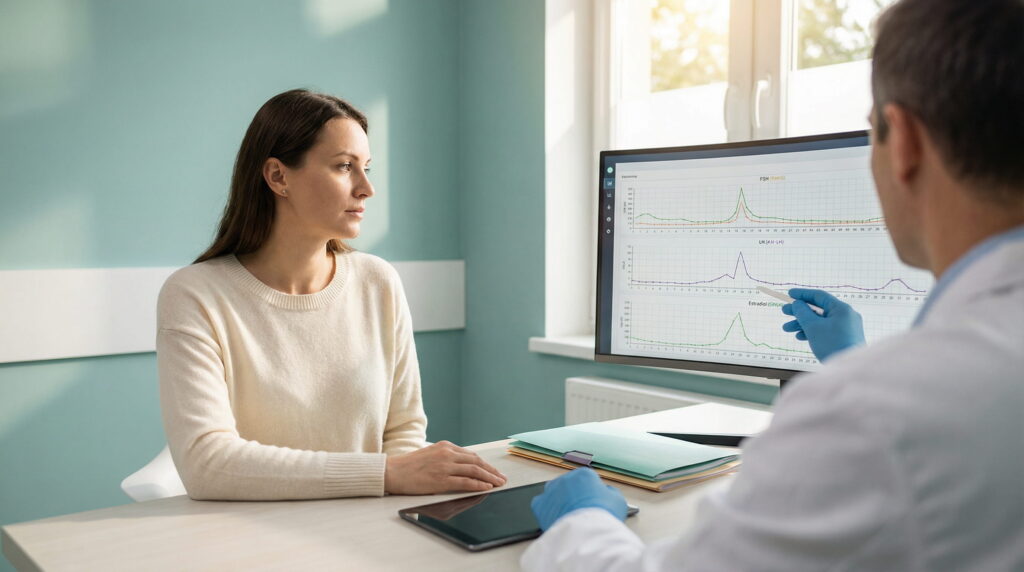
Hormonal testing is recommended when there is suspicion of irregular ovulation, endocrine symptoms, or when pregnancy is delayed and a structured evaluation is needed. In practice, tests are most valuable when integrated into a complete plan: consultation + ultrasound and, when appropriate, investigations for both partners.
There are situations where hormonal evaluation makes sense earlier—especially when there are signs the cycle isn’t predictable or a hidden cause may exist. Common examples include:
- irregular cycles, absent periods, or major month-to-month variation
- intermenstrual bleeding or very heavy periods
- symptoms suggestive of thyroid dysfunction (persistent fatigue, sensitivity to cold/heat, weight fluctuation, palpitations)
- signs of hyperandrogenism (persistent acne, excessive hair growth, androgen-pattern hair loss)
- history of miscarriage or difficulty maintaining pregnancy
- significant pelvic pain or severe period pain, which may raise suspicion of endometriosis and require an integrated approach, including discussion about endometriosis treatment, depending on reproductive goals
It’s also useful to remember that fertility is evaluated as a couple issue. Sometimes hormonal testing is recommended for the male partner as well—especially if semen analysis is abnormal or an endocrine cause is suspected.
How to prepare for hormonal blood tests
Preparation is usually simple, but it helps to avoid factors that can distort interpretation. Prolactin and certain endocrine axes, in particular, can be influenced by stress, poor sleep, and intense physical effort.
As a quick reference, these measures are typically enough:
- the day before: avoid very intense workouts and aim for normal sleep
- the morning of the blood draw: try to arrive without rushing (acute stress can influence some values)
- tell the team if you’re taking hormonal treatments (contraceptives, progesterone, thyroid medication), because this changes interpretation
- note the first day of your period and your usual cycle length (essential for correct scheduling and interpretation)
In a clinical setting, it also matters how the panel is organized: what belongs in a baseline set, what is added only if indicated, and when repeating a test is necessary if it was drawn on the wrong day. For workflow details and test selection, you can consult the Hormonal Tests page.
Which cycle day matters most
“Correct timing” is one of the most important conditions for useful results. The idea that “all hormonal fertility tests are done on day 21” is one of the most common misconceptions. In reality, this mainly applies to progesterone—and only in cycles where ovulation occurs around day 14.
Think of hormonal testing as having two key windows:
1) Early follicular phase (usually cycle days 2–5)
This is when baseline hormones such as FSH, LH, and estradiol (E2) are commonly measured because interpretation is more standardized.
2) Luteal phase (about 7 days after ovulation)
This is where progesterone belongs—used to confirm ovulation and assess whether the luteal phase is adequate.
If cycles are irregular or ovulation timing is unclear, progesterone timing is individualized. Sometimes monitoring (ovulation tests, ultrasound) is needed so the test answers the right question instead of creating confusion.

Essential hormonal tests in women
In most cases, evaluation starts with a “baseline” set because it offers reference points about ovarian function, ovulation, prolactin, and thyroid status. Even here, the goal isn’t “test everything,” but to obtain information that changes decisions.
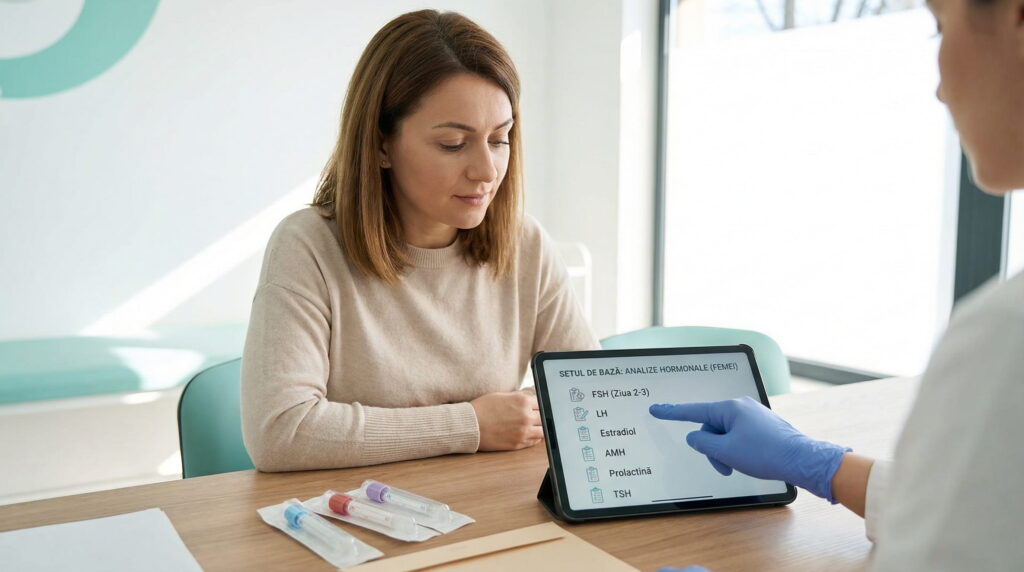
FSH and LH
FSH and LH are pituitary hormones involved in follicle recruitment and ovulation. They only make sense when interpreted in relation to cycle day and the rest of the panel. For example, a value that looks “atypical” on its own may be perfectly explainable if estradiol is elevated or if that cycle was slightly different.
Clinically, these values are not read as “yes/no,” but as part of a broader picture: they can suggest how the ovary is functioning and whether further testing is justified.
Estradiol (E2)
Estradiol reflects follicular activity and helps contextualize FSH. A higher E2 in early follicular phase can change how FSH is interpreted and may require correlation with ultrasound—so E2 is often useful in initial testing when aiming for a realistic picture of ovarian function in that cycle.
Progesterone
Progesterone is the practical marker most commonly used to confirm ovulation. The key is timing: if drawn too early it may look “low” even if ovulation is about to happen; if drawn too late it may naturally fall and falsely suggest a luteal phase problem.
That’s why correct interpretation starts with: “When did ovulation occur?” Sometimes repetition or correlation with ovulation monitoring is recommended for a reliable answer.
Prolactin
Persistently elevated prolactin can disrupt ovulation and contribute to irregular or anovulatory cycles. However, it’s one of the most sensitive tests to draw conditions. Acute stress, poor sleep, and intense exercise can influence results. If prolactin is elevated, the first step is often to confirm whether the blood draw conditions were appropriate, then decide whether repetition or additional investigation is needed.
TSH (± FT4, thyroid antibodies)
Thyroid dysfunction can influence ovulation and pregnancy outcomes. TSH is an important marker, but sometimes it is not enough on its own. Depending on symptoms, history, and the result, FT4 and/or thyroid antibodies may be added. Interpretation should match reproductive goals—not only the lab’s “normal range.”
AMH (Anti-Müllerian Hormone)
AMH is a marker of ovarian reserve and is very useful for planning and prognosis—especially when discussing a medium-term strategy. It’s important to know that AMH does not “measure fertility” in an absolute way. It provides information about ovarian reserve and expected ovarian response, not a guarantee (or impossibility) of pregnancy.
Hormonal tests added based on context
Beyond the baseline set, additional tests are used when there is a real clinical indication. The key is why the test is being ordered.
For example, in suspected PCOS or hyperandrogenism, androgen testing may be recommended (total/free testosterone, DHEA-S, androstenedione), sometimes alongside metabolic evaluation, because insulin resistance can affect ovulation and change treatment strategy.
In selected cases, 17-OH progesterone may be useful, especially when excluding specific endocrine causes that can mimic PCOS. These tests are not “standard for everyone,” and their value increases when used in a targeted way.
Hormonal testing in men
Male factor fertility is essential and should not be delayed. Semen analysis is usually the first step, but hormonal testing can be useful in selected contexts (for example, abnormal semen analysis, suspected hypogonadism, or suggestive clinical signs).
A male hormonal panel may include FSH, LH, testosterone, prolactin, and sometimes TSH, and results are always interpreted alongside clinical context and semen analysis.
“You deserve to be heard, seen, treated with respect, and supported throughout your life.”

Andreas Vythoulkas
Specialist in Obstetrics and Gynecology


Common mistakes that lead to unclear results
Often the issue isn’t the test itself, but how it was done or interpreted. Common examples include:
- measuring progesterone on “day 21” without knowing when ovulation occurred
- drawing baseline tests outside cycle days 2–5, then interpreting them as if timing were correct
- interpreting prolactin after poor sleep, a stressful trip, or intense physical effort
- drawing conclusions from one value without ultrasound or clinical context
In these situations, the most helpful step is often simple: correct timing + contextual interpretation—before moving on to unnecessary tests.
What happens after hormonal testing
Once results are available, the best question isn’t only “Are they normal?” but “What do they mean for our plan?” Depending on the findings, your doctor may recommend:
- correlating results with ultrasound (ovarian appearance, antral follicle count, indirect ovulation signs)
- repeating a test if timing was not appropriate
- targeted additional investigations (uterus, tubes, male factor, metabolic profile)
- treatment for an identified endocrine cause (thyroid, prolactin), if relevant
When multiple factors are present, reproductive time is critical, or the attempt period is long, assisted reproduction may be discussed—including IVF—depending on medical recommendation and your goals.
Frequently Asked Questions
Which cycle day are fertility hormonal tests done?
Most baseline tests are drawn on cycle days 2–5. Progesterone is typically measured about 7 days after ovulation, not automatically on “day 21.” In irregular cycles, timing is individualized.
Is AMH done on a specific cycle day?
AMH can be drawn on any day of the cycle. It must be interpreted in context (age, ultrasound, reproductive goal), not in isolation.
Does progesterone confirm ovulation?
Yes, if it’s measured at the right time after ovulation. If drawn too early or too late, it may be inconclusive and may need repeating or correlation with ovulation monitoring.
Is a “normal” TSH enough when trying to conceive?
Often yes, but it depends on the value, symptoms, and history. Sometimes FT4 and/or thyroid antibodies are recommended by your doctor.
Can high prolactin affect fertility?
Persistently elevated prolactin can disrupt ovulation and contribute to irregular cycles. If prolactin is elevated, draw conditions are checked first; depending on level, the test may be repeated or further investigations may be recommended.
Can hormonal tests diagnose infertility on their own?
They can identify endocrine imbalances that contribute to infertility, but they are usually not sufficient alone for a complete diagnosis. In practice, they are interpreted alongside ultrasound and evaluation of both partners.
If AMH is low, can you still get pregnant?
Low AMH suggests reduced ovarian reserve, but it does not exclude pregnancy. Age, ovulation, semen analysis, and overall context matter; the plan is individualized.
Do you need hormonal tests if your cycle is regular?
Sometimes yes, especially if pregnancy is delayed or specific symptoms are present. A regular cycle is a good sign, but it does not fully exclude thyroid issues, hyperprolactinemia, or other endocrine causes.
Why Choose Genesis Athens for Hormonal Tests
At Genesis Athens, hormonal tests are integrated into a coherent medical evaluation, so that the results are relevant for decision-making. This means selecting the appropriate panel for your specific situation, scheduling blood sampling on the correct days of the cycle, and interpreting the results in context, in order to obtain a clear plan for the next steps.
In addition, when there is suspicion of conditions that may influence fertility, it is important that the evaluation does not stop at laboratory tests alone, but also includes appropriate therapeutic directions. For a complementary perspective on the therapeutic approach, you may also consult the page on endometriosis treatment.
If assisted reproduction options are being discussed, it is useful to have a clear understanding of the stages and indications. You can find additional information on the in vitro fertilization (IVF) page.
For details about the role of the main hormonal assays and the organization of sampling according to your clinical context, you may also refer to the dedicated hormonal tests page.
Speak with a specialist about
Hormonal Tests

Sources:
- ASRM – Progesteron și faza luteală (peak 6–8 zile după ovulație)
- NIH/PMC – Progesteronul variază mult; o singură valoare poate fi limitată
- Mayo Clinic Laboratories – Prolactina poate crește cu somn, stres, efort
- NHS (Leeds) – AMH se poate recolta în orice zi a ciclului
- ESHRE – Ghid endometrioză (diagnostic & management, inclusiv infertilitate)
Hormonal Tests for Infertility
Specialist in Obstetrics and Gynecology
Similar Articles

Egg Donation | What It Is, How It Works & When It’s Advised
Specialist in Obstetrics and Gynecology

Female Infertility Period: After How Long Should You Seek Help and What Options Exist
Specialist in Obstetrics and Gynecology

Early Signs of Pregnancy: Which Symptoms May Appear in the First Days
Specialist in Obstetrics and Gynecology